Ever feel like you’re working for your business instead of on your business?
You answer emails, schedule meetings, update spreadsheets, write content, and chase follow-ups. Then you repeat the same routine tomorrow. It’s exhausting. And if you’re running a small business, hiring people for every task isn’t always an option.
That’s exactly why Agentic AI Tools have become one of the biggest business trends in 2026. Unlike regular AI chatbots that wait for instructions, these tools can plan tasks, make decisions, and complete entire workflows with minimal human input. Think of them as digital team members rather than simple assistants.
I’ve tested dozens of AI tools while working with SaaS businesses on SEO and link-building campaigns. Some looked impressive in demos but created more work than they saved. Others quietly became part of our daily workflow. This guide focuses on the ones that actually help businesses save time and grow.
Let’s start with the first 10 tools worth your attention.
What Are Agentic AI Tools?
Most people think AI is just about generating text or answering questions.
But Agentic AI Tools go a step further.
Instead of waiting for every instruction, they can break down a goal into smaller tasks, decide what to do next, use different apps, and complete work on their own.
Imagine asking an employee:
“Find new leads, write personalized emails, schedule meetings, and update our CRM.”
A traditional chatbot would only help with one step.
An AI agent can handle the entire sequence.
That’s why businesses are rapidly adopting AI workflow automation for repetitive work.
Honestly, this is where most businesses get confused. They buy an AI chatbot expecting automation, but what they actually need is an AI agent.
Now let’s look at the tools making this possible.
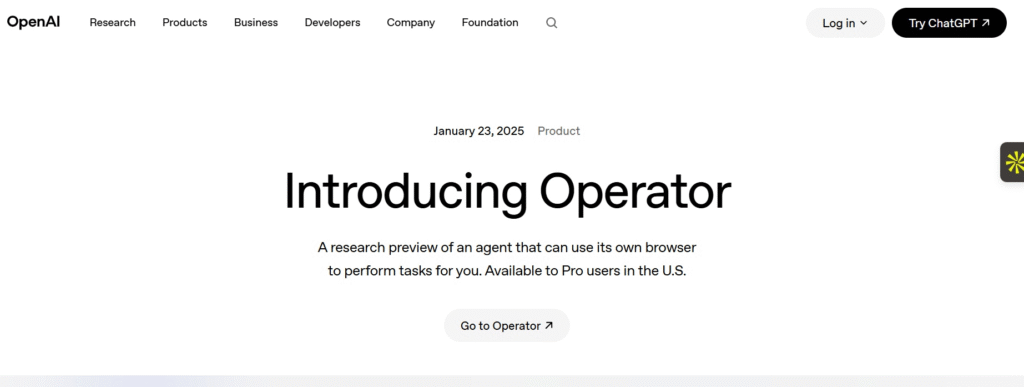
1. OpenAI Operator
OpenAI Operator acts like a digital employee that can browse websites and complete online tasks for you.
Instead of simply answering questions, it can perform actions inside a browser.
Best for
- Online research
- Booking services
- Filling forms
- Website navigation
- Repetitive browser work
Why people like it
Imagine your sales team needs 100 company websites checked every week.
Instead of opening every website manually, Operator can visit pages, collect information, and complete repetitive actions.
That alone can save several hours every week.
Pros
- Works directly inside web browsers
- Understands multi-step tasks
- Handles repetitive workflows
Cons
- Still needs human supervision for sensitive actions
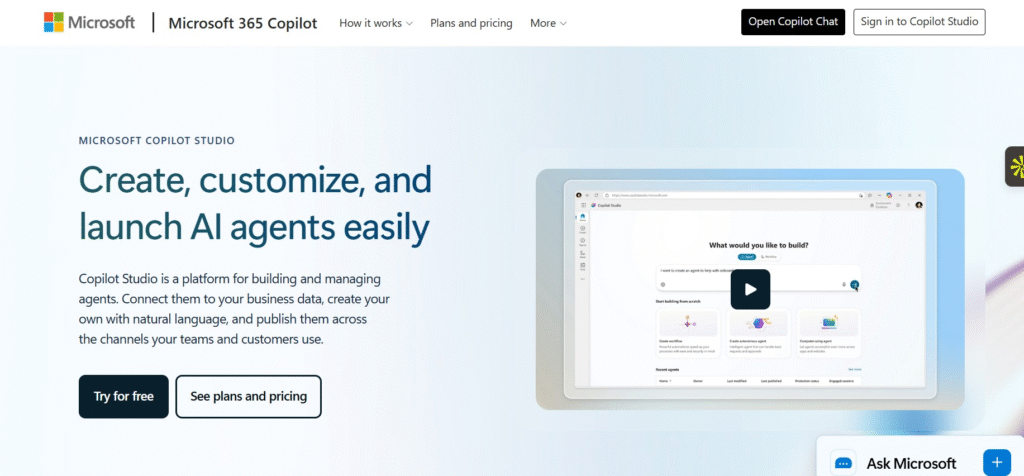
2. Microsoft Copilot Studio
If your business already uses Microsoft 365, this is one of the easiest places to build AI agents.
Copilot Studio allows companies to create custom AI assistants that connect with Outlook, Teams, Excel, SharePoint, and other Microsoft apps.
Best for
- Internal business automation
- HR
- Customer support
- Document workflows
A small accounting firm, for example, can build an agent that reads client emails, extracts invoice details, updates Excel sheets, and sends confirmation messages automatically.
That’s work many teams still do manually.
Personally, I think Microsoft has made AI adoption much easier for non-technical businesses.
3. Google Agentspace
Google Agentspace brings together Gemini AI, Google Workspace, and enterprise search.
Instead of searching across Gmail, Drive, Docs, and Sheets individually, an AI agent can find information across everything.
Best for
- Knowledge management
- Internal search
- Team productivity
- Google Workspace users
Google reports that employees often spend nearly 20% of their workweek searching for information. AI agents dramatically reduce that time by finding exactly what you need in seconds.
That means less searching and more actual work.
4. Salesforce Agentforce
Salesforce has taken CRM automation much further with Agentforce.
Instead of reminding your sales team about follow-ups, it can actually draft emails, qualify leads, summarize conversations, and prepare customer records.
Best for
- Sales teams
- Customer support
- CRM automation
- Lead management
Picture a SaaS company receiving hundreds of demo requests every month.
An AI agent can categorize leads, assign priorities, send personalized responses, and notify the right salesperson.
That’s a lot faster than manual sorting.
5. CrewAI
CrewAI has become one of the most talked-about Best AI agents for businesses wanting multiple AI assistants working together.
Instead of having one AI do everything, CrewAI lets different agents take different roles.
For example:
- One researches competitors
- One writes reports
- One checks facts
- One creates summaries
It works surprisingly well because every agent focuses on one responsibility.
Think of it like running a relay race instead of asking one runner to finish the entire course.
That small difference often produces much better results.
Quick Tip 💡
Don’t automate everything at once.
Start with one repetitive task that takes your team at least an hour every day. Once that workflow runs smoothly, move to the next one.
Businesses usually see better results with gradual automation than trying to replace every process overnight.
6. AutoGen
Created by Microsoft Research, AutoGen helps multiple AI agents communicate with each other.
Rather than completing isolated tasks, agents collaborate until a goal is achieved.
Best for
- Software development
- Research
- Data analysis
- Multi-agent collaboration
Developers especially like AutoGen because it can review code, suggest fixes, and test solutions using different specialized agents.
While it’s more technical than other tools on this list, businesses with development teams can save significant time.
7. LangGraph
LangGraph has become popular among companies building complex AI systems.
It gives developers more control over how AI agents think, remember information, and make decisions.
Best for
- Enterprise AI
- Custom AI workflows
- Complex automation
Most small businesses won’t need LangGraph immediately.
But if you’re building AI products or advanced SaaS platforms, it’s one of the strongest frameworks available.
That’s why many AI startups are adopting it early.
8. Zapier AI Agents
Zapier has always been known for connecting apps.
Now its AI agents add intelligence on top of those automations.
Instead of following fixed rules, the agent can decide what action should happen next.
Best for
- Marketing
- CRM updates
- Email automation
- Small businesses
Imagine someone submits a contact form.
The AI agent can:
- Research the company
- Score the lead
- Send a customized email
- Create a CRM record
- Notify your sales team
All without anyone clicking a button.
For small businesses, that’s one of the simplest ways to start using AI workflow automation.
9. Lindy AI
Lindy works like an executive assistant that never gets tired.
It manages emails, meetings, scheduling, follow-ups, reminders, and many administrative tasks.
Best for
- Founders
- Consultants
- Agencies
- Busy professionals
I’ve seen agency owners spend two hours every day just organizing emails.
Lindy reduces much of that routine work, allowing owners to spend more time talking to clients instead of managing calendars.
That’s often a better investment of your time.
10. Relevance AI
Relevance AI helps businesses create custom AI agents without needing deep programming knowledge.
You can design workflows for customer support, operations, marketing, HR, and sales.
Best for
- No-code automation
- Customer service
- Internal operations
- Marketing teams
Businesses can create agents that answer customer questions, qualify leads, generate reports, and connect with existing software.
One thing I appreciate is how approachable it feels compared to many enterprise AI platforms. You don’t need to be an engineer to build something useful.
11. Devin AI
Devin AI made headlines because it’s designed to work like an AI software engineer rather than just a coding assistant.
It can plan projects, write code, test applications, fix bugs, and even explain what it changed. While it’s aimed at developers, business owners running SaaS products can use it to speed up software development.
Best for
- Software teams
- SaaS startups
- Bug fixing
- Product development
Pros
- Handles complete development tasks
- Explains its reasoning
- Learns from previous work
Cons
- Best suited for technical teams
12. Manus AI
Manus AI is one of the newest autonomous AI tools getting attention in 2026.
Instead of generating a quick answer, it works independently until the assigned goal is complete. Whether that’s researching competitors, creating reports, or collecting market data, it keeps working without constant prompts.
Best for
- Market research
- Competitor analysis
- Business planning
One founder shared that instead of spending an afternoon comparing competitors, Manus AI delivered a detailed report before lunch. That doesn’t replace human thinking, but it certainly speeds up the research phase.
Personally, I see tools like Manus becoming everyday business assistants over the next few years.
13. Adept AI
Adept AI focuses on helping businesses work inside existing software rather than replacing it.
Instead of learning another platform, employees can simply ask the AI to complete tasks inside applications they already use.
Best for
- Office productivity
- Enterprise software
- Workflow automation
Imagine telling your AI:
“Generate this month’s sales report and email it to the management team.”
Instead of switching between Excel, Outlook, and dashboards, the AI performs those actions automatically.
Sometimes saving a few clicks hundreds of times a month makes a bigger difference than buying another expensive tool.
14. Amazon Bedrock Agents
If your business runs on AWS, Amazon Bedrock Agents are worth exploring.
They allow companies to build AI agents that connect securely with databases, APIs, and internal systems.
Best for
- Enterprise businesses
- AWS users
- Customer support
- Internal automation
Amazon designed these agents with security and scalability in mind, making them suitable for businesses handling sensitive customer information.
That said, smaller companies may find simpler no-code options easier to start with.
15. IBM watsonx Orchestrate
IBM has been building business AI for years, and watsonx Orchestrate brings that experience into workflow automation.
It automates repetitive office tasks across HR, finance, procurement, and customer service.
Best for
- Large organizations
- HR automation
- Finance teams
- Enterprise operations
According to IBM, employees spend a significant part of their workday on repetitive administrative tasks. AI agents help reduce that workload by taking over routine processes.
Most people think automation only saves time. But actually, reducing repetitive work often improves employee satisfaction too.
16. Oracle AI Agents
Oracle’s AI Agents are built for businesses already using Oracle Cloud applications.
These agents help automate finance, supply chain management, procurement, and customer operations.
Best for
- Large enterprises
- ERP automation
- Financial operations
For example, an AI agent can identify delayed supplier payments, notify the finance team, and prepare reports automatically.
If your company already depends on Oracle, adding AI agents feels like a natural next step rather than starting from scratch.
17. HubSpot AI Agents
HubSpot has expanded beyond CRM by introducing AI agents that help marketing, sales, and customer service teams work faster.
Best for
- Small businesses
- Marketing agencies
- Sales automation
- Customer support
An AI agent inside HubSpot can:
- Reply to common customer questions
- Qualify leads
- Schedule meetings
- Recommend follow-up emails
- Update CRM records automatically
As someone working with SaaS companies, I’ve noticed that many agencies already spend their day inside HubSpot. Having automation built into the same platform removes a lot of unnecessary switching between tools.
18. Airtable AI
Many businesses already use Airtable to organize projects.
Now Airtable AI turns those databases into intelligent workflows.
Best for
- Project management
- Content planning
- Marketing teams
For example, a content marketing team can automatically:
- Generate article briefs
- Assign writers
- Track publishing status
- Create summaries
- Update project dashboards
If you’ve ever managed content in endless spreadsheets, you know how quickly things become messy. Airtable AI helps keep everything organized without extra manual work.
19. n8n AI Agent
Unlike many expensive enterprise platforms, n8n is open-source and highly flexible.
It lets businesses connect hundreds of applications while adding AI decision-making into the workflow.
Best for
- Developers
- Growing startups
- Custom automation
A simple workflow might look like this:
Website Form → AI Qualifies Lead → CRM Updated → Slack Notification → Personalized Email Sent
Everything happens automatically.
That’s why many startups prefer n8n over expensive enterprise automation software.
20. Gumloop
Gumloop has quickly become a favorite among no-code users who want powerful AI automation without writing code.
Its visual builder makes creating AI workflows surprisingly simple.
Best for
- Entrepreneurs
- Marketing teams
- Agencies
- Operations
You can build workflows that:
- Research companies
- Extract data
- Write personalized emails
- Summarize documents
- Generate reports
- Connect with tools like Google Sheets, Notion, Slack, and Gmail
For many small businesses, Gumloop offers a practical way to experiment with autonomous AI tools before investing in larger enterprise platforms.
How to Choose the Right Agentic AI Tool
With so many options available, it’s easy to feel overwhelmed.
Here’s a simple way to narrow your choices:
| If you want to… | Consider… |
| Automate office work | Microsoft Copilot Studio |
| Improve sales | Salesforce Agentforce |
| Automate marketing | HubSpot AI |
| Connect different apps | Zapier AI Agents |
| Build custom workflows | n8n or Gumloop |
| Manage Google Workspace | Google Agentspace |
| Build enterprise AI | Amazon Bedrock or IBM watsonx |
| Coordinate multiple AI agents | CrewAI or AutoGen |
Honestly, don’t chase the tool with the most features. Choose the one that solves your biggest daily problem first.
Common Mistakes Businesses Make
Many companies buy AI software expecting instant results.
But these mistakes usually slow them down:
- Trying to automate every process on day one.
- Ignoring data quality before automation.
- Expecting AI to replace human judgment.
- Choosing enterprise software when a simpler tool would work.
- Never measuring how much time automation actually saves.
The businesses seeing the best results usually start with one repetitive task, test it, improve it, and then expand.
Frequently Asked Questions
What are Agentic AI Tools?
Agentic AI Tools are AI systems that can plan, make decisions, and complete multi-step tasks with minimal human input. Unlike regular chatbots, they don’t simply answer questions—they actively perform work.
Which is the best AI agent for small businesses?
For most small businesses, Zapier AI Agents, HubSpot AI, Gumloop, and Microsoft Copilot Studio offer the easiest starting point because they require little or no coding.
Are autonomous AI tools replacing employees?
Not really. Most businesses use AI to handle repetitive work while employees focus on strategy, creativity, customer relationships, and decision-making. Think of AI as an assistant rather than a replacement.
Can I use AI workflow automation without coding?
Yes. Many modern platforms like Relevance AI, Gumloop, Airtable AI, HubSpot AI, and Zapier AI are built specifically for non-technical users.
Are Agentic AI Tools worth the investment?
If your team spends hours every week on repetitive work, the answer is usually yes. Even saving one or two hours per employee each week can lead to significant productivity gains over time.
Final Thoughts
The rise of Agentic AI Tools isn’t just another technology trend—it’s changing how businesses get work done. The biggest advantage isn’t replacing people. It’s giving your team more time to focus on creative thinking, customer relationships, and business growth.
Start small. Pick one repetitive workflow, automate it, measure the results, and build from there. That’s how most successful businesses adopt AI without creating unnecessary complexity.
And if your goal is to grow your SaaS business beyond automation, remember that AI can help you work faster, but you still need strong SEO, quality content, and authoritative backlinks to get found online. If you’d rather have that handled by experts, Saalinko is here to help. Your next stage of growth starts with one smart decision at a time.